
Clean-in-place (CIP) systems are automated cleaning systems that flush cleaning solutions through equipment without requiring disassembly. In food processing—especially meat, poultry, dairy, and ready-meal production—this matters because product residues are rich in protein, fat, and sugar—conditions that allow bacteria to multiply quickly if sanitation is inconsistent. Food plants must thoroughly clean equipment between production runs while minimizing downtime. CIP systems solve this by automating the cleaning process across production lines.
This guide explains how clean in place food processing systems work, how they compare to manual cleaning, and how they support CIP food safety and regulatory compliance in modern food processing and packaging facilities.
What Does CIP Stand For?
CIP stands for Clean-in-Place. It refers to an automated sanitation method that cleans the internal surfaces of closed equipment—pipes, tanks, pumps, valves, heat exchangers, and fillers—by circulating cleaning solutions through the system at controlled temperatures and flow rates. The equipment remains assembled during the process; operators do not dismantle the line to clean it.
A programmed sequence typically runs several stages: rinse, wash, rinse, and sanitize. Each stage uses specific temperatures, chemical concentrations, and circulation times to remove food residues and microorganisms.
CIP is often paired with COP (Clean-out-of-Place). COP applies to removable parts that are taken off the line and cleaned separately in wash stations. In food processing plants the two systems work together: CIP handles fixed, closed-circuit equipment while COP addresses removable components such as guards, trays, and detachable fittings.
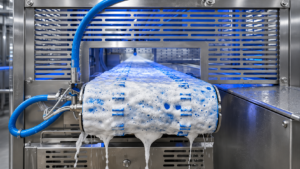
Open equipment is a third category. Conveyors, thermoformers, slicers, and tray sealers have no closed circuit for cleaning solution to circulate through, so they are cleaned with foam or open-plant cleaning, or with spray systems built into the machine. A complete sanitation program usually combines all three: CIP for closed circuits, COP for removable parts, and foam or spray cleaning for open surfaces.
How CIP Works — Step by Step
Below is a typical CIP cycle used for automatic cleaning of food production lines in food processing.
Step 1: Pre-rinse
→ Ambient or warm water flush to remove loose product residue
→ Duration: 3–5 minutes
→ Removes ~90% of visible soil
Step 2: Caustic wash (alkaline detergent)
→ Hot caustic solution (typically 1–2% NaOH, 65–75°C)
→ Duration: 10–20 minutes
→ Breaks down protein and fat deposits
Step 3: Intermediate rinse
→ Clean water flush to remove caustic residue
→ Duration: 3–5 minutes
Step 4: Acid wash (if required)
→ Acid solution (typically phosphoric or nitric acid, 0.5–1%)
→ Duration: 5–10 minutes
→ Removes mineral scale and hard water deposits
→ Not always required — depends on water hardness and product type
Step 5: Final rinse
→ Clean water, sometimes heated
→ Duration: 3–5 minutes
Step 6: Sanitize
→ Chemical sanitizer (peracetic acid, chlorine dioxide, or QAC) or hot water (>82°C)
→ Duration: 5–10 minutes
→ Reduces microbial load to safe levels before next production run
A full CIP cycle typically runs 45–90 minutes. The six stages above account for roughly 25–55 minutes of wash and rinse time; the rest is circuit setup, draining between stages, and verification. Circuit size, equipment complexity, and soil levels determine where a given line falls in that range. Modern systems store multiple cleaning “recipes,” allowing different machines or production zones to run customized cycles. Sensors monitor flow rate, temperature, chemical concentration, and conductivity throughout the cycle. Each parameter is logged automatically, producing verification records that can be reviewed during food safety audits.
CIP vs Manual Cleaning
In many food processing plants the decision between CIP and manual cleaning is primarily an operational question. Manual sanitation relies on operators to dismantle equipment, spray surfaces, scrub residues, and reassemble the line. CIP systems automate most of that work. The comparison below applies to closed-circuit equipment such as piping, tanks, and fillers; typical figures vary by plant.
|
Factor |
CIP (Automated) |
Manual Cleaning |
|---|---|---|
|
Cleaning time per cycle |
45–90 minutes |
2–4 hours |
|
Labor required |
1 operator (monitoring) |
3–6 operators (active cleaning) |
|
Water usage per cycle |
200–500 liters (recirculated) |
500–1,500 liters (single-pass) |
|
Chemical usage |
Precise, metered dosing |
Variable — operator-dependent |
|
Cleaning consistency |
Repeatable — same parameters every cycle |
Variable — depends on operator skill and diligence |
|
Documentation |
Automatic data logging (time, temp, concentration, flow) |
Manual log sheets — often incomplete |
|
Equipment disassembly required |
Minimal to none |
Significant — guards, conveyors, nozzles |
|
Validation / audit readiness |
High — automated records support BRC, SQF, FSSC 22000 audits |
Low — difficult to prove consistency |
|
Risk of recontamination |
Low — closed system |
Higher — open equipment, manual handling |
|
Capital cost |
Higher (CIP station, piping, controls) |
Lower (hoses, spray guns, tanks) |
|
Operating cost per cycle |
Lower (less water, chemical, labor) |
Higher (more labor, water, chemical waste) |
|
Typical payback period |
Often 12–24 months at >40 production hours/week (illustrative estimate) |
— |
The financial impact is straightforward to estimate. Illustrative example: a line running two shifts per day and sanitized daily might recover 1.5–3 hours of production time per cleaning event by switching from manual cleaning to CIP. Over about 250 production days, that adds up to roughly 375–750 hours of additional capacity per year. At even modest output values, recovered production time alone can offset the capital investment within 12–24 months. Actual payback depends on output value per hour, utility and chemical costs, and installation scope, so run the numbers with your own production data before building a business case.
Regulatory Requirements
Food safety regulations rarely mandate specific sanitation technologies, but they do require facilities to demonstrate effective and documented cleaning procedures. CIP systems align closely with those expectations.
FDA / FSMA (United States) Under the Food Safety Modernization Act, food facilities must implement preventive controls that include monitored sanitation procedures. Facilities must verify that cleaning occurs as planned and maintain records demonstrating compliance. CIP systems automatically log parameters such as temperature, time, and chemical concentration, creating documentation that satisfies these monitoring and verification requirements.
EU Regulation 852/2004 This regulation requires food business operators to maintain equipment that can be cleaned effectively and, when necessary, disinfected. It also requires equipment design that allows adequate sanitation. While CIP is not explicitly required, automated cleaning systems support the regulation’s emphasis on hygienic design and documented cleaning processes.
Third-party food safety certification programs (BRC, SQF, FSSC 22000) Most large food manufacturers operate under certification schemes that audit sanitation programs closely. Auditors typically review cleaning procedures, parameter monitoring, and sanitation records. CIP systems provide automatically recorded data showing each stage of the cleaning cycle, which simplifies verification during audits.
For meat, poultry, and ready-to-eat operations in particular, sanitation programs focus heavily on pathogens such as Listeria monocytogenes, Salmonella, and pathogenic E. coli. Automated CIP monitoring improves traceability and consistency in sanitation programs—an advantage when demonstrating compliance with modern CIP food safety expectations.
CIP systems are also one part of a broader hygienic design strategy. Equipment geometry, drainage, and accessibility all affect sanitation effectiveness. (See Velec’s guide to hygienic design for food processing equipment for more on that topic.)
Where CIP Fits in a Food Processing Line
CIP systems connect to the closed parts of a line, where product flows through pipes, vessels, and dosing equipment and residues accumulate out of sight. Typical CIP circuits include:
- Product transfer piping and pumps
- Filling and dosing systems
- Mixers, hoppers, and closed vessels
- Valves, heat exchangers, and inline components
- Intermediate storage tanks or buffers
In sausage packaging lines, for example, product residues can accumulate in transfer pipes and filling systems during production. Integrating CIP allows operators to flush these areas quickly between batches. (See the complete sausage packaging line solution for an example of a CIP-ready configuration.)
Open equipment downstream, such as conveyors, thermoformers, and tray sealers, is handled differently. Because there is no closed circuit, these machines are cleaned with foam, open-plant cleaning, or integrated spray systems. Equipment designed for fast washdown typically includes self-draining frames, smooth welds, and accessible spray coverage. Velec’s conveyor solutions incorporate hygienic features that make washdown faster and more consistent.
Sanitation performance also depends on broader equipment design choices. Automated cleaning systems work best when paired with hygienic surfaces, minimal dead zones, and tool-free access points. (See the article on ensuring food safety in automated processing lines for more context.)
FAQ
What does CIP stand for in food safety?
CIP stands for Clean-in-Place. It is an automated sanitation method used in food processing that circulates cleaning solutions through equipment without requiring disassembly. The system runs programmed cleaning cycles using controlled temperatures, flow rates, and chemical concentrations to remove food residues and microorganisms between production runs.
What is the difference between CIP and manual cleaning?
CIP systems clean closed equipment such as pipes, tanks, and fillers automatically by circulating cleaning solutions through it. Parameters such as temperature, chemical concentration, and flow rate are programmed and monitored for consistency. Manual cleaning relies on operators to dismantle equipment and clean surfaces with hoses and scrubbing tools. CIP cycles are faster, more consistent, and produce automatic sanitation records, while manual cleaning is more labor-intensive and harder to document.
Is CIP required by food safety regulations?
Most food safety regulations do not specifically require CIP systems. However, frameworks such as FSMA in the United States, EU Regulation 852/2004, and third-party audit standards like BRC, SQF, and FSSC 22000 require documented sanitation procedures and verified cleaning effectiveness. CIP systems simplify compliance by automatically recording the parameters of each cleaning cycle.
How long does a CIP cycle take?
A typical CIP cycle takes 45–90 minutes, including setup and draining. The process includes a pre-rinse, caustic wash, intermediate rinse, optional acid wash, final rinse, and sanitization stage. The exact duration depends on circuit size, equipment complexity, and the amount of residue present. Equivalent manual cleaning usually takes 2–4 hours, with less consistent results.
Clean-in-Place Systems and Hygienic Packaging Equipment
Clean-in-place systems work best when equipment is designed to support sanitation from the start. Surfaces must drain properly, crevices must be minimized, and connections must allow cleaning solution flow throughout the system.
Velec packaging lines incorporate these principles across our equipment range, including CIP-compatible connections, hygienic conveyor designs, and tool-free disassembly where manual access is required.
Talk to our engineering team about CIP-ready line configurations →