
Centrifugal Organization for IQF Patties & Burgers: 2027 Buyer’s Guide
Producing frozen patties at scale sounds simple—until thousands of IQF burgers come out of the freezer in a chaotic, overlapping flow. For many processors, that moment becomes the hidden bottleneck in the IQF Burger Line: throughput drops, robots wait, operators intervene, and the promise of automation quietly erodes. This is where centrifugal organization has become a defining technology in modern IQF operations.
As SKU counts rise, labor remains tight, and buyers demand higher consistency, food producers are rethinking how frozen patties are organized, counted, and fed into packaging. Centrifugal feeder patties systems offer a fundamentally different approach—using controlled centrifugal force to separate, orient, and stabilize IQF burgers before downstream automation takes over. When designed correctly, they unlock higher speeds, better accuracy, and more predictable performance across the entire line.
This guide breaks down how centrifugal organization fits into today’s IQF automation strategies. We’ll walk through how IQF burger lines actually work, where organization problems arise, how centrifugal systems compare to conveyors and robotics alone, and what business owners should consider when evaluating ROI, hygiene, flexibility, and future expansion. If you’re planning a new line—or fixing a struggling one—this article is your practical roadmap for 2027 and beyond.
Quick Takeaways: Centrifugal Organization in IQF Burger Lines
- IQF burger lines succeed or fail at the organization stage. Freezing and packaging often perform as specified, but disorganized patties after the freezer are the most common (and costly) source of lost throughput in IQF automation.
- Centrifugal feeder patties systems stabilize flow before problems compound downstream. By separating, orienting, and spacing IQF burgers early, centrifugal organization protects the performance of counters, loaders, robots, and packaging machines.
- Predictable flow is the goal, not speed. Plants that add centrifugal organization frequently recover 10–20% of effective capacity without upgrading freezers or packers.
- Centrifugal organization complements robotics. When robots receive consistently spaced patties, utilization increases and each robot runs closer to its rated speed.
- Hygienic design and CIP compatibility are non-negotiable. Well-designed centrifugal systems simplify sanitation while supporting multi-SKU, multi-shift production.
- Flexibility matters more in 2027 than peak capacity. Recipe-driven centrifugal systems handle changing patty sizes and private-label SKUs without lengthy mechanical changeovers.
Why IQF Burger Lines Matter More in 2027
IQF burger production has quietly shifted from a “nice-to-have” capability to a strategic necessity. Labor shortages, rising energy costs, and relentless SKU expansion have forced processors to rethink how frozen patties move through their plants. A modern IQF burger line isn’t just about freezing efficiently—it’s about keeping product flowing, predictable, and controllable from freezer discharge all the way to packaging.
One of the biggest changes driving this shift is product variety. Ten years ago, many facilities ran one or two patty formats at high volume. Today, it’s common to see different diameters, thicknesses, protein blends, and private-label specs running on the same line. IQF makes that flexibility possible, but only if downstream automation can keep up.
Industry benchmarks from large frozen food processors show that unplanned micro-stoppages after IQF freezing account for 15–30% of lost line efficiency. Most of that loss doesn’t come from packaging machines; it comes from unstable product organization. That’s why modern IQF automation strategies focus less on headline machine speed and more on flow stability.
For business owners, the takeaway is simple: IQF burger lines are no longer judged by peak capacity alone. They’re judged by how consistently they run across multiple SKUs, multiple shifts, and real-world operating conditions.
What Is an IQF Burger Line?
An IQF burger line is a fully integrated production system designed to freeze, organize, count, and package individual patties without allowing them to stick together or lose shape. Unlike block freezing, IQF preserves product separation, which is critical for automated handling and accurate packaging.
Definition: IQF Patties vs Fresh or Block-Frozen Products
Individual Quick Freezing produces free-flowing, non-agglomerated patties. This enables downstream automation—but it also introduces variability in orientation, spacing, and movement that must be controlled.
Core Modules of a Modern IQF Burger Line
Most automated IQF burger production lines follow a similar structure:
- Patty forming and pre-freezing
- IQF tunnel or spiral freezer
- Product discharge and buffering
- Organization and singulation
- Counting, stacking, or robotic loading
- Primary packaging and case packing
The moment where many lines struggle is step four. IQF freezing creates separation—but not order. Treating organization as an afterthought is where performance starts to slip.
The Hidden Bottleneck in IQF Burger Production: Product Organization
Most IQF lines don’t fail dramatically—they fail quietly. The freezer performs as specified. The packaging machine is capable of high speed. Yet output never reaches expectations. In audits of underperforming lines, the same issue appears again and again: inconsistent IQF frozen patty organization.
Frozen patties exiting an IQF freezer behave unpredictably. Small changes in moisture, fat content, or frost accumulation affect how patties slide, rotate, and overlap. Traditional linear conveyors struggle to correct this randomness at high throughput. Operators compensate by slowing the line or stepping in manually—both of which erode ROI.
OEM field studies consistently show that poor IQF patty singulation and orientation can reduce effective throughput by 20–40%, even when downstream equipment is sized correctly. Worse, variability at this stage compounds downstream, creating counting errors, misloads, and packaging rejects.
The critical insight many buyers miss is this: organization problems amplify as product moves downstream. Fixing flow early often unlocks capacity processors didn’t realize they already owned.
Centrifugal Organization Explained (Plain-English Version)
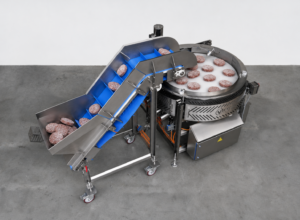
A centrifugal feeder for IQF burgers uses rotational motion to separate, orient, and stabilize frozen patties before they enter precision automation. Instead of forcing products into alignment with guides or gates, the system allows patties to naturally self-space using centrifugal force.
In practice, frozen patties enter the center of a rotating disc. As the disc spins, patties migrate outward, separating from one another and settling into predictable paths. Adjustable guides then transition them smoothly onto downstream conveyors in controlled lanes.
This approach works exceptionally well for centrifugal feeder patties applications because IQF burgers are rigid, round, and relatively uniform in mass. Those characteristics make centrifugal force highly predictable compared to vibration-based or friction-dependent methods.
Despite appearances, centrifugal systems are remarkably gentle. Patties experience fewer abrupt drops and impacts than in many mechanical singulation systems, helping preserve shape, edges, and surface quality—key factors for both appearance and packaging consistency.
Centrifugal Feeder Patties vs Other Organization Methods
When buyers evaluate organization technologies for an IQF burger line, they typically compare three options:
Centrifugal vs Linear Conveyor Alignment
Linear conveyors are simple and low-cost, but they struggle with overlapping products at higher speeds and offer limited correction for variability.
Centrifugal Organization and Robotic Lines
Robotic pick-and-place lines offer the most flexibility, especially for frequent format changes and mixed SKUs. They are a larger investment. Centrifugal organization suits high-volume lines running consistent patty formats. Many plants combine the two: a centrifugal infeed presents patties evenly, so robots pick at full speed.
Centrifugal vs Vibratory or Mechanical Singulation
Vibratory systems can be aggressive on frozen products and are less predictable as product conditions change.
Centrifugal organization occupies the middle ground—delivering stable, high-throughput flow while reducing the burden on robotics. In hybrid IQF automation lines, centrifugal systems routinely improve robot utilization by 15–25% simply by delivering consistent spacing.
Where Centrifugal Organization Fits in an IQF Burger Line
Centrifugal organization delivers the most value when it’s positioned immediately after the IQF freezer discharge or following a short buffer conveyor. At this point in the process, patties are fully frozen but still highly variable in orientation and spacing—exactly where centrifugal systems excel.
In a typical IQF patty handling system, centrifugal organization feeds:
- Counting systems for fixed-count packs
- Stackers for layered or shingled presentation
- Robotic pick stations that require predictable spacing
By stabilizing flow at this stage, the centrifugal system acts as a shock absorber for upstream variability. Freezer fluctuations, frost buildup, or minor forming inconsistencies no longer ripple through the rest of the line.
One overlooked benefit is layout efficiency. Because centrifugal systems combine buffering and organization into a compact footprint, they often replace long, inefficient conveyor runs. In retrofit projects, this can free up floor space and simplify sanitation zones. This advantage rarely shows up in early project scopes but matters long term.
Throughput, Accuracy, and OEE: The Real Payoff
The strongest argument for centrifugal organization isn’t theoretical; it shows up directly in OEE metrics. Plants that add centrifugal feeders to existing IQF automation lines consistently report:
- Higher sustained throughput (not just peak speed)
- Fewer micro-stoppages caused by misfeeds
- More accurate counting and stacking
- Reduced operator intervention
OEM field data and customer case studies show that processors often recover 10–20% of effective capacity without changing freezers or packaging machines. That’s capacity that already existed but was unreachable due to unstable product flow.
From a business owner’s perspective, this is critical. Increasing throughput by upgrading freezers or packers is capital-intensive and disruptive. Recovering lost capacity through better organization delivers ROI faster and with less operational risk.
Just as important, predictable flow improves planning confidence. When throughput is stable, production schedules tighten, labor planning improves, and downstream logistics become easier to manage.
Hygiene, Food Safety, and Frozen-Product Realities
Frozen food environments amplify hygiene challenges. Condensation, temperature gradients, and frequent washdowns demand equipment designed specifically for these conditions.
Modern centrifugal systems for IQF burgers feature:
- Open stainless-steel frames
- Sloped surfaces for drainage
- Tool-less access for inspection
- CIP-compatible designs
This matters because poor hygienic design often negates automation gains. Equipment that’s fast but difficult to clean creates sanitation bottlenecks, limits SKU flexibility, and increases downtime between runs.
Well-designed centrifugal systems simplify sanitation rather than complicating it—an essential requirement for multi-shift, multi-SKU operations.
Packaging Compatibility: How IQF Organization Supports End-of-Line Success
Centrifugal organization directly improves packaging performance—regardless of format. Whether feeding thermoformers, tray sealers, or baggers, consistent infeed spacing is essential for:
- Accurate counts
- Clean sealing
- Reduced mispacks
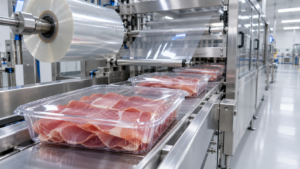
This is where organization connects back to packaging strategies such as vacuum or MAP. Even the best packaging technology underperforms when product arrives inconsistently. Stable flow improves seal integrity, reduces rework, and protects shelf-life performance.
In high-speed lines, centrifugal organization often enables packaging machines to run closer to their rated capacity—without increasing reject rates.
Changeovers, Flexibility, and SKU Explosion
SKU proliferation is the current reality. Private-label contracts, seasonal promotions, and protein diversification all demand flexibility.
Modern centrifugal systems support:
- Multiple patty diameters and thicknesses
- Recipe-driven adjustments via HMI
- Fast changeovers without mechanical rebuilds
For facilities running mixed SKUs, this flexibility often outweighs peak speed considerations. Designing for adaptability upfront prevents costly retrofits later.
ROI Considerations for Business Owners and Buyers
When evaluating the ROI of IQF automation systems, centrifugal organization often delivers one of the fastest payback periods in the line.
ROI drivers include:
- Labor reduction and redeployment
- Improved yield and reduced give-away
- Recovered capacity without new freezers
- Fewer quality-related rejects
In high-volume IQF burger lines, payback periods of 12–24 months are common—sometimes faster when centrifugal systems replace manual intervention or help robots run closer to rated speed.
Common Mistakes When Designing an IQF Burger Line
The most frequent mistake is underestimating product organization complexity. Automation rarely fails because machines are slow—it fails because flow is unstable.
Other common missteps include:
- Planning robot cells without a consistent infeed
- Designing for today’s SKU mix instead of tomorrow’s
- Treating organization as an afterthought rather than a core module
High-performing lines design organization first and let everything else build around it.
How to Specify the Right Centrifugal Solution
When specifying centrifugal organization for an IQF burger line, buyers should focus on:
- Throughput range (current and future)
- Patty size variability
- Cleaning access and sanitation time
- Footprint and integration support
The best system fits the product and operating reality—not just the layout drawing.
2027 Trends in IQF Burger Line Automation
Looking ahead, the trend is clear: smarter, modular systems that stabilize flow early and optimize continuously.
Key trends include:
- Recipe-driven HMIs
- Modular expansions instead of full line replacements
- Data-driven optimization of frozen food lines
Centrifugal organization is increasingly viewed as foundational infrastructure, not optional equipment.
Final Takeaway: Why Centrifugal Organization Is the Backbone of High-Performance IQF Burger Lines
Modern IQF burger production isn’t constrained by freezing technology or packaging speed—it’s constrained by how well frozen patties are organized once they leave the freezer. As this guide has shown, centrifugal organization addresses that challenge at its source.
By stabilizing flow early, centrifugal feeder patties systems unlock higher throughput, better accuracy, smoother changeovers, and stronger ROI across the entire IQF burger line. Just as importantly, they support the realities of 2027 production: SKU complexity, tight labor markets, and uncompromising hygiene standards.
If you’re planning a new IQF line—or struggling to hit targets on an existing one—the smartest place to start is with product organization. Talk with an automation partner who understands centrifugal systems in real frozen environments, and design for stability first. Everything downstream will follow.
Frequently Asked Questions (FAQs)
What is a centrifugal feeder and why is it used in an IQF burger line?
A centrifugal feeder uses rotational force to separate and orient frozen patties after IQF freezing. In an IQF burger line, it stabilizes flow before counting, loading, or packaging, improving throughput and accuracy.
Can centrifugal organization replace robots in IQF automation?
No—centrifugal systems complement robotics. By delivering evenly spaced patties, they allow robots to operate closer to rated speed and get more output from each robot.
Where does a centrifugal feeder fit in an IQF patty handling system?
Centrifugal feeders are typically installed after freezer discharge or buffering. They feed counters, stackers, robotic pick stations, and packaging machines.
Are centrifugal feeder patties systems hygienic enough for frozen food production?
Yes. Modern systems feature open stainless designs, drainage, and CIP compatibility—essential for frozen environments.
What ROI can processors expect from centrifugal organization?
Many processors see payback within 12–24 months, driven by recovered capacity, labor savings, and improved yield.
Want to Explore What This Looks Like in Your Facility?
Every IQF operation is different. Product geometry, throughput targets, SKU mix, and layout constraints all affect how centrifugal organization should be applied.
If you’re evaluating upgrades or planning a new IQF burger line, it’s worth reviewing how centrifugal systems could stabilize your flow and protect your downstream automation. The right conversation early can eliminate years of incremental fixes later.
References
Internal (Velec Systems)
- Velec Systems. IQF Burger Line — Complete IQF Patties Packing Line.
https://www.velecsystems.com/your-products/patties/ - Velec Systems. IQF Patties Loader.
https://www.velecsystems.com/your-products/patties/ - Velec Systems. The Centrifugal Machine: The Perfect Solution for Organizing IQF Burgers.
https://www.velecsystems.com/the-centrifugal-machine-the-perfect-solution-for-organizing-iqf-burgers/ - Velec Systems. Centrifugal Counting Solution.
https://www.velecsystems.com/our-solutions/centrifugal-machine/ - Velec Systems. Understanding Total Cost of Ownership in Food Processing Equipment.
https://www.velecsystems.com/understanding-total-cost-of-ownership-tco-in-food-processing-equipment/
External
- Acemia. IQF Burger Line.
https://www.acemia.fr/en/filiere/processed-products-production/IQF-burger-line/ - Individual Quick Freezing. Wikipedia.
https://en.wikipedia.org/wiki/Individual_quick_freezing - OctoFrost. How OctoFrost Is Transforming Hamburger Freezing.
https://octofrost.com/octofrost-hamburger-impingement-freezing/