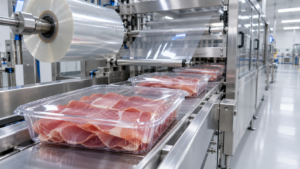

Thermoforming remains the workhorse of high-volume food packaging — meat trays, MAP packs, cheese cavities, ready-meal containers. But the materials and machines behind those packs are shifting fast. The EU’s Packaging and Packaging Waste Regulation (PPWR) took effect in August 2027, and North American retailers are tightening their own recyclability requirements. For operations teams and procurement professionals, the question is no longer whether to move toward sustainable thermoforming but which film, which machine upgrade, and on what timeline.
This guide covers the practical options: mono-material and recyclable film structures available now, the energy-efficiency gains built into modern servo-driven thermoformers, and the regulatory deadlines that will shape your next equipment and materials decisions. If you’re already tracking line performance, our OEE benchmarking guide provides the metrics framework to quantify what sustainability improvements actually deliver to your bottom line.
The Sustainability Challenge in Thermoforming
Traditional thermoforming films are multi-layer structures — PA/PE, PET/PE, EVOH barrier sandwiches — engineered for shelf life and forming performance. The problem: mixed-polymer laminates are effectively non-recyclable in conventional waste streams. When a consumer drops a multi-material tray into a recycling bin, it ends up in residual waste or contaminates a single-polymer bale.
This creates a two-part challenge for food processors. First, regulatory: the EU PPWR mandates that all packaging placed on the market must be recyclable by 2030, with design-for-recyclability requirements that began in August 2027. Second, commercial: major retailers including Tesco, Carrefour, and Walmart have set recyclability targets ahead of regulation, and they’re pushing those requirements upstream to their suppliers.
The good news is that film suppliers and machine OEMs have responded with practical solutions. Mono-material structures are closing the performance gap with traditional laminates, and modern thermoformers are designed to run these newer materials without sacrificing cycle time or pack integrity.
Recyclable & Mono-Material Films: Your Options in 2027
Mono-material films use a single polymer family throughout the structure — all-PE or all-PP — so they can be sorted and recycled in existing curbside streams. Below is a comparison of the primary film families available for thermoforming today, with their recyclability status, barrier properties, and typical applications.
|
Film Type |
Polymer |
Recyclability |
O₂ Barrier |
Best For |
|
Mono-PE |
PE (all layers) |
Recyclable in PE stream |
Low — requires coating or scavenger |
Fresh meat trays, short-shelf MAP |
|
Mono-PP |
PP (all layers) |
Recyclable in PP stream |
Moderate |
Cheese, ready meals, hot-fill |
|
Mono-PET / rPET |
PET / rPET (30–50% PCR) |
Recyclable in PET stream |
Good (inherent PET barrier) |
Deli trays, salads, produce |
|
PE + EVOH (mono-compatible) |
PE with thin EVOH layer (<5%) |
Recyclable under CEFLEX guidelines |
High |
MAP sausage, sliced meat, long-shelf |
|
Bio-based PE |
Bio-PE (sugarcane) |
Recyclable in PE stream |
Low — same as fossil PE |
Drop-in replacement, carbon-offset goals |
|
Coated mono-PE |
PE + SiOx or AlOx coating |
Recyclable in PE stream |
High (vacuum-deposited barrier) |
High-barrier MAP, replacing PA/PE |
The fastest-moving segment is coated mono-PE. Vacuum-deposited SiOx and AlOx barrier coatings applied to a mono-PE base deliver oxygen transmission rates competitive with traditional PA/PE laminates while remaining recyclable in standard PE streams. Several film converters now offer these structures in thicknesses from 100 µm to 250 µm, suitable for deep-draw thermoforming.
For sausage and processed meat applications — where barrier performance is non-negotiable — the PE + EVOH route remains the pragmatic choice. CEFLEX guidelines accept up to 5% EVOH by weight in a PE structure as compatible with flexible PE recycling. This directly affects how you configure your thermoformer loading systems and MAP gas-flush parameters.
[PLACEHOLDER: Confirm with Velec engineering: any forming-parameter differences (temperature, dwell time) observed when switching from PA/PE to coated mono-PE on Velec-integrated thermoformers?]
Energy Efficiency Gains in Modern Thermoformers
Sustainability in thermoforming isn’t only about the film. The machine itself is a significant energy consumer — heating stations, servo drives, vacuum pumps, and compressed-air systems all draw power. Modern thermoformers are delivering meaningful reductions across all four areas.
Servo-Drive Technology
Servo-driven thermoformers replace hydraulic and pneumatic actuators with electric servo motors for forming, sealing, and cutting movements. The efficiency gain is substantial: servo drives consume energy only during active motion phases and can regenerate energy during deceleration, feeding it back into the machine’s power bus. Industry data shows 20–37% energy reduction compared to equivalent hydraulic machines running the same cycle at the same output.
Heating Zone Optimization
Advanced thermoformers use multi-zone ceramic or quartz heaters with individual PID control per zone. This eliminates the common problem of over-heating the entire sheet to compensate for cold spots. When paired with real-time film-temperature monitoring, these systems reduce heating energy by 15–20% while improving forming consistency — which in turn reduces scrap rates and boosts the quality component of your OEE.
Vacuum and Compressed-Air Efficiency
Vacuum pump technology has shifted toward variable-speed dry-running pumps that adjust capacity to actual demand rather than running at full speed continuously. Similarly, plug-assist and pressure-forming systems now use optimized air circuits that minimize compressed-air waste — often the most expensive utility in a food plant per unit of useful work delivered.
|
Technology Area |
Typical Savings vs. Previous Generation |
Payback Period |
|
Servo drives (replacing hydraulic) |
20–37% electrical reduction |
2–4 years |
|
Multi-zone PID heating |
15–20% heating energy reduction |
1–3 years |
|
Variable-speed vacuum pumps |
10–25% vacuum system savings |
1–2 years |
|
Regenerative braking on servo axes |
5–10% recovered energy |
Included in servo upgrade |
|
Intelligent standby / auto-sleep |
3–8% total machine energy |
Firmware — no hardware cost |
Quantifying these gains requires reliable baseline data. If you’re not already tracking energy per pack or kWh per cycle, the methodology in our OEE guide provides the framework to establish those baselines before and after an upgrade.
Regulatory Trends: EU PPWR and US State-Level Rules
The regulatory landscape for packaging is moving faster than many food processors expected. Here’s what matters for thermoforming operations.
EU: The PPWR Timeline
|
Date |
Requirement |
Impact on Thermoforming |
|
Aug 2027 |
PPWR general application date; packaging design and minimization rules take effect |
All new packaging designs must comply with material-efficiency and substance restrictions (including PFAS limits on food-contact materials) |
|
Aug 2028 (or 24 months after the EU implementing act) |
Harmonized material-composition labels (QR code or digital carrier allowed on small packs) |
Packaging artwork will need to carry the harmonized material labels; plan label space now |
|
2030 |
All packaging must be recyclable; minimum recycled content targets for plastic packaging |
Multi-material laminates that cannot be recycled in practice will be non-compliant; mono-material transition must be complete |
|
2030–2040 |
Escalating recycled-content minimums for plastic packaging |
rPET and rPE sourcing strategies become critical; film converter partnerships matter |
United States: A Patchwork Approach
The US lacks a federal equivalent to the PPWR, but state-level action is accelerating. California, Colorado, Oregon, and Maine have passed Extended Producer Responsibility (EPR) laws that impose fees based on packaging recyclability. Several states have banned expanded polystyrene food-service packaging, and PFAS restrictions in food-contact packaging are spreading rapidly.
For food processors operating in both markets, the practical move is to design to the stricter EU standard. A pack that meets PPWR recyclability requirements will satisfy any current US state regulation, and avoids the cost of maintaining parallel packaging specifications for different regions.
Making the Transition: Practical Steps
Switching films is not just a procurement decision — it affects forming parameters, seal integrity, shelf-life validation, and potentially your entire end-of-line packaging configuration. A structured approach reduces risk.
Start with your highest-volume SKU, not your most complex one. Run forming trials on your existing thermoformer with the candidate mono-material film at your current cycle time. Document forming depth, corner definition, seal strength, and leak rate. If the film requires a wider forming window (lower temperature or longer dwell), calculate the throughput impact and decide whether to absorb it, adjust the cycle, or invest in a machine upgrade.
Validate shelf life under your actual supply-chain conditions, not just accelerated lab testing. A mono-PE pack with a SiOx coating may deliver 80% of the oxygen-barrier performance of a PA/PE laminate — but whether that’s enough depends on your distribution chain temperature, transit time, and retailer display conditions.
Involve your equipment partner early. Thermoformer OEMs can advise on tooling changes, heating-zone reconfiguration, and whether your current machine can handle the new material’s forming characteristics. If you’re planning a line upgrade, the hygienic design principles that Velec builds into its equipment ensure that sustainability improvements don’t come at the cost of food-safety compliance.
FAQ
Q: Can mono-material films match the shelf life of traditional multi-layer laminates?
Not always, but they’re closing the gap. Coated mono-PE films with SiOx or AlOx barriers now achieve oxygen transmission rates within 15–20% of PA/PE structures. For many fresh-meat and processed-meat applications, this is sufficient. Longer-shelf products may still need PE + EVOH structures, which are accepted as recyclable under CEFLEX guidelines when EVOH content stays below 5%.
Q: How much energy can a modern servo-driven thermoformer save compared to an older hydraulic model?
Industry data consistently shows 20–37% electrical energy savings from the servo-drive upgrade alone. When combined with multi-zone heating optimization and variable-speed vacuum pumps, total machine energy reductions of 30–45% are achievable. Payback on the energy savings component typically falls within 2–4 years depending on local electricity costs and utilization rates.
Q: When does the EU PPWR actually take effect?
The general application date is 12 August 2027. From that date, packaging design and substance restrictions apply. The recyclability mandate — requiring all packaging to be recyclable — applies from 2030. Recycled-content minimums for plastic packaging phase in between 2030 and 2040.
Q: Do US food processors need to worry about PPWR?
If you export to the EU or supply retailers with EU operations, yes — your packaging must comply. Even for US-only operations, designing to PPWR standards is increasingly practical because US state-level EPR laws are converging on similar requirements, and major US retailers are imposing recyclability requirements that mirror EU direction.
Q: Will switching to recyclable film require new thermoforming tooling?
It depends on the film. Some mono-material films have different forming characteristics — they may need a wider forming window, adjusted plug-assist profiles, or recalibrated heating zones. In many cases, existing tooling works with parameter adjustments. Your thermoformer OEM or film supplier can run trials to confirm compatibility before you commit to a full switchover.
Ready to Future-Proof Your Packaging Line?
Whether you’re evaluating recyclable film options, planning a thermoformer energy audit, or scoping a full line upgrade, Velec’s engineering team can help you build a transition plan that protects shelf life, meets regulatory deadlines, and delivers measurable ROI.