Your packaging process probably worked fine when volumes were lower. Now it’s the bottleneck. Orders take longer to ship, staffing is harder, and the people you do hire spend most of their shift loading trays, sealing packs, or stacking cases.
This guide helps you decide if it’s time to automate your packaging line, what stage of the process to automate first, and what the investment typically looks like at different production levels. If you’re running a small-to-mid-size food operation, the goal is simple: understand the decision before committing capital.
When Should You Automate Your Packaging Line?
This is a diagnostic checklist:
You’re probably ready to automate if:
- You’re running more than 30 hours/week of production and can’t add shifts due to labor constraints
- You’re regularly turning down orders because you can’t package fast enough
- Your per-unit packaging labor cost exceeds $0.15–0.20 per pack
- You’ve had product quality rejections caused by inconsistent manual packaging (seal failures, underweight packs, label errors)
- A retail customer requires packaging specs (MAP, specific tray formats, date coding) your manual process can’t reliably deliver
- More than 25% of packaging labor hours are spent on end-of-line tasks like case packing or palletizing
- Worker’s compensation costs tied to repetitive strain in packaging are increasing
It’s probably too early if:
- You’re running fewer than 15 hours/week of production
- Your product line changes constantly and each run requires a different setup
- Your facility can’t support automation utilities such as compressed air or higher electrical loads
- Your packaging format isn’t stable yet (you’re still experimenting with sizes, recipes, or pack configurations)
Most food manufacturers reach the automation inflection point when they’re running 30–50 hours per week of production with four or more operators dedicated to packaging. Below that range, the payback stretches too long. Above it, manual packaging usually becomes the most expensive part of the operation.
Types of Packaging Automation by Line Speed
Automation rarely happens all at once. Most businesses automate in stages as throughput increases.
The table below maps typical production speeds to the kinds of automated food packaging systems that make sense at each stage.
Your Current Volume | What to Automate First | Typical Equipment | Approximate Investment* | Expected Impact |
|---|---|---|---|---|
5–15 packs/min (startup / artisan) | Don’t automate yet — optimize manual process | Ergonomic workstations, semi-auto case erector, label applicator | $5K–25K | 15–25% throughput increase |
15–30 packs/min (growing) | Primary packaging | Entry-level thermoformer or semi-auto tray sealer | $50K–150K | 2–3× throughput, consistent seals, MAP capability |
30–60 packs/min (established) | Primary packaging + loading | Thermoformer with automatic product loading | $150K–400K | Removes 2–4 manual loading positions, consistent pack quality |
60–100 packs/min (scaling) | Primary + secondary + EOL | Integrated thermoform or flow-wrap line, automated case packing, semi-auto palletizing | $400K–800K | Full-line automation with 2–3 operators |
100+ packs/min (high-volume) | End-to-end automation | High-speed thermoforming or flow-wrap systems with robotic loading, case packing, palletizing | $800K–2M+ | Minimal operator intervention |
*Industry investment ranges for illustration only.
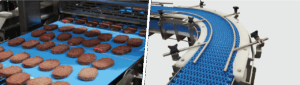
Several supporting systems connect these stages of automation. Conveyors move products between machines. End-of-line packaging systems handle case packing and palletizing once primary packaging is automated.
Automate in stages. For most growing food producers, the highest-ROI starting point is primary packaging. Replacing manual tray loading and hand sealing with a thermoformer or automated tray sealer often doubles or triples throughput while cutting labor per pack by 40–60%.
The second stage is end-of-line automation. Case packing and palletizing usually involve the most repetitive manual work, so automation there often produces the fastest labor payback.
If you want to see how a full automated line integrates these stages, the automated sausage packaging line example shows how loading, packaging, conveying, and case packing connect in a single system.
ROI Framework — Payback by Production Volume
A simplified payback model helps estimate when automation makes financial sense. These figures assume a blended U.S. labor cost of roughly $18–22/hour fully loaded.
Production Volume | Manual Packaging Labor (est. annual) | Automated Packaging Labor (est. annual) | Annual Labor Savings | Typical Equipment Cost | Simple Payback |
|---|---|---|---|---|---|
20 hrs/week, 3 operators | ~$95,000 | ~$45,000 (1.5 operators) | ~$50,000 | $80K–150K | 1.5–3 years |
40 hrs/week, 5 operators | ~$200,000 | ~$75,000 (2 operators) | ~$125,000 | $200K–400K | 1.5–3 years |
60 hrs/week, 8 operators | ~$370,000 | ~$110,000 (3 operators) | ~$260,000 | $400K–800K | 1.5–3 years |
Labor savings are only the visible portion of the return. Automation in food packaging also reduces product giveaway from inconsistent fills, packaging waste from seal failures, and quality returns caused by manual errors. Injury claims tied to repetitive tasks typically decline as well. These indirect savings often add 20–40% on top of direct labor reductions.
For a deeper financial breakdown, see the guide on Total Cost of Ownership in food processing equipment. That framework helps compare automation proposals beyond sticker price and identify long-term operating costs.
These types of improvements fall under broader packaging efficiency solutions — changes that reduce cost per pack while increasing throughput and consistency.
Implementation Roadmap
The automation process typically unfolds over about a year. The steps below outline the common sequence from planning to full production.
Month 1–2: Assessment & Specification
→ Document current throughput, labor costs, reject rates
→ Define target throughput and packaging format
→ Identify which stages to automate first
→ Request proposals from equipment suppliers
Month 3–4: Equipment Selection & Facility Prep
→ Evaluate proposals (compare on TCO, not sticker price)
→ Confirm facility requirements (floor space, utilities, drainage)
→ Order equipment (typical lead time: 8–16 weeks)
Month 5–8: Build & Installation
→ Equipment manufacturing at supplier facility
→ Factory acceptance test (FAT) before shipment
→ Site preparation: utilities, floor, drainage
→ Equipment installation and commissioning
Month 9–10: Startup & Optimization
→ Operator training
→ Production ramp-up (expect ~60–70% OEE initially)
→ Optimize changeovers, speeds, cleaning cycles
→ Track OEE weekly
Month 11–12: Steady State
→ Line reaches target throughput
→ OEE tracking established
→ First ROI review vs original projections
From assessment to steady production, the process typically takes 9–12 months. The most common mistake is skipping the first step and choosing equipment before documenting current performance.
Spending a few weeks measuring throughput, reject rates, and labor allocation provides a baseline for evaluating proposals and calculating ROI later. Using OEE as your baseline metric makes it easier to track improvements once the automated system is running.
FAQ
How much does food packaging automation cost?
Costs depend on the level of automation. An entry-level thermoformer or semi-automatic tray sealer typically falls in the $50K–150K range. A fully integrated automated food packaging system with robotic loading, case packing, and palletizing can reach $800K–2M+. Most growing food manufacturers begin automation projects in the $150K–400K range, adding equipment as production volume increases.
What should I automate first in a food packaging line?
Primary packaging usually delivers the biggest operational improvement. Upgrading from manual tray sealing to an automated thermoformer or flow-wrapper increases throughput, stabilizes seal quality, and reduces labor per pack. Once primary packaging is automated, the next stage is typically end-of-line automation, including case packing and palletizing.
How long does it take to see ROI on packaging automation?
Most automation projects achieve simple payback within 1.5–3 years based on labor savings alone. When secondary benefits are included — reduced packaging waste, fewer quality rejections, and lower injury rates — the effective payback is often shorter. The ROI framework table above shows typical scenarios by production volume.
Ready to Scope Your First Automation Project?
Tell us your current production volume and packaging format, and we’ll help you identify the first stage of automation that makes sense.