





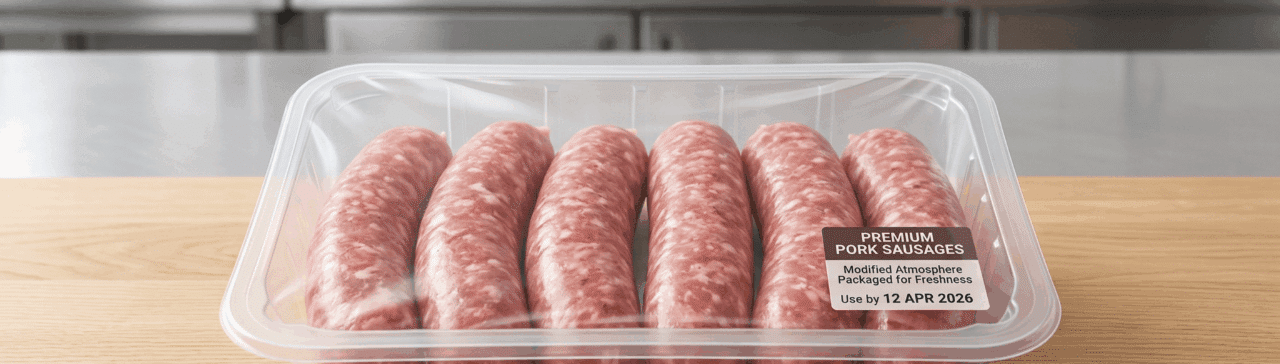
Modified atmosphere packaging (MAP) is a packaging technique that replaces the air inside a sealed package with a controlled gas mixture to slow spoilage and extend shelf life. Its primary applications span fresh and processed meats, cheese, bakery products, ready meals, and fresh produce—essentially any refrigerated retail product where shelf life determines profitability. MAP is the dominant packaging technology in the retail chilled aisle for shelf-life-sensitive products, and its adoption continues to grow as retailers push for longer code dates and consumers demand fresher products without chemical preservatives. This guide covers the science behind how MAP works, recommended gas mixtures by product type, shelf life extension data across major food categories, equipment and film requirements for MAP lines, cost analysis and ROI justification, and how MAP compares to vacuum sealing. Whether you are evaluating modified atmosphere packaging for a new line or optimizing an existing operation, this page serves as a practical reference for food processors, packaging engineers, and quality assurance teams.
What Is Modified Atmosphere Packaging?
When food is sealed in a standard package with normal air—78% nitrogen, 21% oxygen, and 1% trace gases—oxygen drives spoilage. It feeds aerobic bacteria, accelerates oxidation (causing rancidity and color loss), and supports mold growth. Modified atmosphere packaging solves this by replacing the air inside the sealed package with a gas mixture tailored to the specific product. The three gases used in virtually all MAP applications are carbon dioxide (CO₂), which directly inhibits the growth of most aerobic bacteria and molds; nitrogen (N₂), which is an inert filler gas used to displace oxygen and prevent package collapse; and in some applications, oxygen (O₂), which is retained at controlled levels to maintain the color of fresh red meat or support the respiration of fresh produce. The modified atmosphere slows these degradation pathways, extending usable shelf life without chemical preservatives. The result is a product that stays fresher longer while maintaining its natural appearance, texture, and flavor profile.
Standard Atmosphere 78% N₂ / 21% O₂ / 1% other • Oxygen feeds bacteria • Oxidation degrades color and flavor • Shelf life: 3–7 days | Modified Atmosphere (MAP) Tailored gas mix (e.g., 30% CO₂ / 70% N₂) • CO₂ inhibits bacterial growth • N₂ displaces oxygen • Shelf life: 14–28 days |
Figure 1: How MAP Works — Standard Atmosphere vs. Modified Atmosphere
MAP is also called “gas-flush packaging,” “modified air packaging,” or “protective atmosphere packaging” depending on region and industry. In French-speaking markets, the standard terms are “conditionnement sous atmosphère modifiée” or “emballage sous atmosphère protectrice.”
Gas Mixtures by Food Type
The gas mixture used in MAP is not a one-size-fits-all formula. Each product category has specific spoilage mechanisms that respond to different gas compositions. The table below provides recommended gas mixes for the most common MAP-packaged food categories, along with the functional role of each gas component. These are industry-standard starting points—fine-tuning for your specific product and production conditions is always recommended.
Food Category | Typical Products | Recommended Gas Mix | Role of Each Gas |
Fresh red meat | Steaks, ground beef, lamb chops | 70–80% O₂ / 20–30% CO₂ | High O₂ maintains red oxymyoglobin color; CO₂ inhibits bacteria |
Cooked / processed meat | Frankfurters, ham slices, cooked sausage | 30% CO₂ / 70% N₂ | No O₂ needed (color set by curing/cooking); CO₂ extends shelf life |
Fresh sausage (uncured) | Pork sausage, bratwurst, chicken sausage | 20–30% CO₂ / 70–80% N₂ | Low CO₂ slows spoilage; N₂ as filler; O₂ excluded to slow oxidation |
Cured / dry sausage | Salami, chorizo, dry-cured sausage | 20% CO₂ / 80% N₂ or 100% N₂ | Minimal gas interaction needed; N₂ prevents pack collapse |
Hard cheese | Cheddar, Parmesan, Gouda | 100% CO₂ or 30% CO₂ / 70% N₂ | CO₂ inhibits mold; N₂ prevents pack collapse in low-CO₂ mixes |
Soft cheese | Brie, Camembert, fresh mozzarella | 30% CO₂ / 70% N₂ | Lower CO₂ to avoid acidic taste absorption; N₂ as filler |
Bakery products | Bread, tortillas, crumpets, croissants | 100% CO₂ or 50% CO₂ / 50% N₂ | CO₂ for mold inhibition; N₂ adds cushion for fragile products |
Ready meals | Pre-cooked pasta, prepared salads, meal kits | 30% CO₂ / 70% N₂ | Balanced preservation without flavor impact |
Fresh pasta | Ravioli, filled pasta, fresh noodles | 50% CO₂ / 50% N₂ | Higher CO₂ for higher moisture content |
Fresh produce | Salad mixes, cut fruit, herbs | 2–5% O₂ / 5–10% CO₂ / bal. N₂ | Low O₂ slows respiration without killing tissue; CO₂ inhibits decay |
Gas mix selection is product-specific and not negotiable—using the wrong mix can accelerate spoilage rather than prevent it. Fresh red meat is the most counterintuitive case: it requires high oxygen (70–80%) to maintain the bright red oxymyoglobin color consumers expect, even though oxygen generally promotes spoilage. The CO₂ component in that mix handles the bacterial inhibition. For products where O₂ is excluded, even small residual oxygen levels (>0.5%) can significantly reduce shelf life, which makes film barrier properties and seal integrity critical. Gas suppliers and packaging equipment manufacturers can provide product-specific mix recommendations, but you should always validate with shelf life testing on your actual product under your production conditions.
Shelf Life Extension Data
The primary commercial justification for MAP is shelf life extension. The table below provides representative shelf life ranges for common products under MAP versus standard air packing, all assuming proper refrigeration at 0–4°C. The “multiplier” column shows how many times longer the product lasts under MAP compared to air—this is the number that drives the ROI calculation for most processors. Temperature control is the single most important variable after the gas mix itself: a MAP pack held at 8°C instead of 2°C can lose half its shelf life advantage.
Product | MAP Shelf Life (0–4°C) | Without MAP / Air Pack | Multiplier |
Cooked sausage / frankfurters | 21–28 days | 5–7 days | 3–5× |
Fresh pork sausage | 10–14 days | 3–5 days | 2–3× |
Fresh chicken sausage | 7–12 days | 2–4 days | 2–3× |
Smoked sausage / kielbasa | 28–42 days | 10–14 days | 2–3× |
Dry/cured sausage (sliced) | 60–90 days | 30–45 days | 2× |
Sliced cooked ham | 21–35 days | 4–6 days | 4–6× |
Fresh ground beef | 8–12 days (high O₂ MAP) | 2–4 days | 3–4× |
Hard cheese (sliced) | 60–90 days | 14–21 days | 3–5× |
Soft cheese | 14–21 days | 5–7 days | 2–3× |
Fresh bread / bakery | 14–21 days | 3–5 days | 3–5× |
Fresh-cut salad | 7–12 days | 2–4 days | 2–3× |
Ready meals | 10–21 days | 3–5 days | 3–4× |
These are representative ranges, not guarantees. Actual shelf life depends on initial microbial load at the time of packaging, cold chain integrity throughout distribution, product formulation (salt content, pH, water activity), film barrier properties (OTR, MVTR), and seal quality. Shelf life validation testing on your specific product with your specific gas mix and packaging materials is always required before setting commercial sell-by dates. Most food safety laboratories offer MAP shelf life studies that include microbial and sensory analysis over the target shelf life period.
For a deeper look at how oxygen impacts sausage shelf life, see The Science of Oxygen Exposure for Sausages.
MAP vs Vacuum Packaging — When to Use Each
MAP and vacuum packaging both extend shelf life by reducing oxygen, but they work differently and suit different applications. Vacuum packaging removes the atmosphere entirely and pulls the film tight against the product, which can compress delicate items and create a less appealing retail appearance. MAP replaces the atmosphere with a tailored gas mix and maintains headspace in the package, preserving product shape and creating a more attractive shelf presentation. The choice between the two depends on product type, retail presentation requirements, cost tolerance, and the distribution chain the product must survive.
Use MAP when: • Retail shelf display matters • Product is delicate or easily compressed • Maximum shelf life is required • Running high-speed tray sealing lines | Use vacuum when: • Selling wholesale or foodservice • Product is firm and not easily damaged • Cost-per-pack is the priority • Running lower-volume or simpler equipment |
For a detailed side-by-side comparison including shelf life data, cost-per-pack analysis, and equipment considerations, see Vacuum Sealing vs MAP for Sausages.
MAP Equipment & Film Requirements
The core MAP packaging system consists of a packaging machine and a gas mixer or supply system. The machine format depends on line speed, pack format, and product type. Capital investment ranges from roughly $30,000–$50,000 for a basic single-chamber tray sealer with gas flush up to $250,000+ for a high-speed inline thermoformer with integrated gas mixing, quality inspection, and labeling. The following table summarizes the four main equipment categories used in MAP operations.
Equipment Type | Description |
Thermoformer with MAP | Forms a tray from bottom web, fills with product, flushes with gas, and seals with top web. Highest throughput. Used for most retail MAP applications. |
Tray sealer with MAP | Pre-formed trays loaded by hand or robot, gas-flushed and sealed. Lower capital cost and speed. Suits medium-volume lines. |
Flow wrapper with gas flush | Gas-flush flow wrapping for pillow-pack formats: bakery, some sausage multipacks, snack products. |
Gas supply system | Either premixed cylinders or an on-site gas mixer blending from bulk N₂ and CO₂ tanks. On-site mixing is more cost-effective above approximately 50 packs/minute. |
Film Requirements
Film Property | Why It Matters for MAP | Typical Specification |
Oxygen Transmission Rate (OTR) | Controls how fast O₂ re-enters the pack after sealing | < 5 cc/m²/24hr for most MAP applications |
Moisture Vapor Transmission Rate (MVTR) | Prevents dehydration and condensation inside the pack | < 10 g/m²/24hr typical |
Seal strength | Prevents gas leakage and microbial contamination | > 15 N/15mm peel strength typical |
Anti-fog treatment | Prevents condensation from obscuring product visibility at retail | Required for retail display applications |
Puncture resistance | Prevents pack damage during handling and transport | Varies by product—sharp bones and frozen items need higher resistance |
Recyclability | Increasingly required by retail and regulatory trends | Mono-material (PE or PP) structures gaining share over multi-layer |
Film selection is as important as gas mix selection. A high-barrier gas mix in a low-barrier film delivers poor shelf life—the gas mixture is only as good as the package’s ability to maintain it. When specifying MAP films, always request OTR and MVTR test data from your film supplier and cross-reference with the gas mix requirements for your specific product. Recyclability is an increasingly important consideration: mono-material PE and PP structures are replacing traditional multi-layer laminates to meet retailer sustainability mandates and extended producer responsibility regulations, though barrier performance in mono-material films continues to improve.
Ongoing quality control is equally critical. In-line or at-line gas analyzers verify that the headspace gas composition matches the target mix on every pack. Leak detection systems—whether based on CO₂ sniffing, pressure decay, or vision inspection—catch seal failures before product reaches distribution. Together, gas analysis and leak detection form the two essential quality checkpoints for any MAP operation.
Is MAP Worth the Investment?
MAP adds cost at two levels: equipment (higher capital investment than a vacuum sealer at equivalent speed) and consumables (gas supply plus higher-barrier film equals a higher cost per pack). The per-pack cost premium for MAP over vacuum is typically $0.04–$0.12 depending on pack size, gas volume, film specification, and line speed. Gas costs alone are typically $0.01–$0.03 per pack when using on-site mixing from bulk tanks, and higher when using premixed cylinders.
The business case for MAP rests on three returns that, for most processors handling shelf-life-sensitive retail products, more than offset the per-pack premium:
Return Driver | Impact |
Extended shelf life reduces waste | A product going from 5-day to 21-day shelf life typically sees a 10–20% reduction in expired or returned product, saving significantly on total product cost. |
Retail access | Most major retailers require MAP for fresh and processed meat in the chilled aisle. Without MAP capability, many listings are simply not available. |
Distribution radius | Longer shelf life means wider shipping range. A product with 7-day shelf life serves a regional market; the same product with 21-day shelf life serves a national market. |
For a detailed cost-per-pack comparison between MAP and vacuum sealing, see Vacuum Sealing vs MAP — Cost, Shelf Life & ROI Compared.
Frequently Asked Questions
What is modified atmosphere packaging?
Modified atmosphere packaging is a technique that replaces the air inside a sealed pack with a controlled gas mixture—typically carbon dioxide (CO₂) and nitrogen (N₂)—to slow spoilage and extend shelf life. It is used widely in retail meat, cheese, bakery, and ready-meal packaging. The specific gas blend is tailored to each product type to target the dominant spoilage mechanisms for that food. Unlike vacuum packaging, MAP maintains headspace inside the pack, preserving the product’s shape and visual appeal on the retail shelf.
What does MAP stand for in food packaging?
MAP stands for Modified Atmosphere Packaging. It is also referred to as gas-flush packaging or protective atmosphere packaging depending on the region and industry context. In French-speaking markets, the standard term is “conditionnement sous atmosphère modifiée” or “emballage sous atmosphère protectrice.” You may also encounter the term “modified atmosphere package” (singular) when referring to an individual pack rather than the technology as a whole.
How long does MAP extend shelf life?
MAP typically extends shelf life 2–5 times compared to air packing, depending on the product and gas mix. Cooked sausage goes from 5–7 days to 21–28 days. Fresh ground beef goes from 2–4 days to 8–12 days. Hard cheese can reach 60–90 days under MAP compared to 14–21 days in air. The exact extension depends on initial product quality, cold chain maintenance, and film barrier properties. See the shelf life extension table above for product-specific data across twelve food categories.
What gas is used in modified atmosphere packaging?
Most MAP applications use a blend of carbon dioxide (CO₂) and nitrogen (N₂). CO₂ is the active antimicrobial component that directly inhibits bacterial growth, while N₂ is an inert filler that displaces oxygen and prevents package collapse. The ratio varies by product—30/70 CO₂/N₂ for cooked meats, 70–80% O₂ with 20–30% CO₂ for fresh red meat (where high oxygen maintains the red color consumers expect), and 100% CO₂ or 50/50 CO₂/N₂ for bakery products. See the gas mixture table above for specific recommendations by food category.
Is MAP packaging more expensive than vacuum packaging?
Yes—typically $0.04–$0.12 more per pack due to gas costs and higher-barrier films. Equipment capital costs are also higher. However, MAP delivers longer shelf life, better retail presentation, and wider distribution capability. Most processors recoup the per-pack premium through reduced product waste, broader market access, and the ability to secure retail listings that require MAP. The payback period for MAP equipment typically ranges from 12 to 24 months for facilities running at moderate to high volume.