





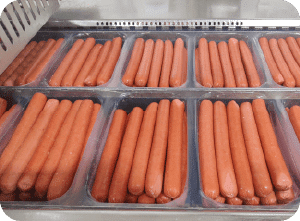
Why OEE Matters in Food Processing – 2026 Benchmarks + Free Calculator
Overall Equipment Effectiveness (OEE) is a single percentage that tells you how much of your scheduled production time is actually producing good product. Food processing lines need OEE more than most — your lines deal with challenges that generic manufacturing benchmarks don’t account for: frequent changeovers between SKUs, mandatory sanitation downtime, and biological product variability that no amount of engineering fully eliminates. This page gives you the formula, a worked example from a sausage packaging line, OEE benchmarks broken out by food processing line type, and a free calculator you can start using today.
What OEE Measures (And What Is TRS?)
The formula first:
OEE = Availability × Performance × Quality
That’s the entire framework. Three components, multiplied together, producing a single percentage that captures every major category of production loss.
Availability — The percentage of scheduled production time that the line is actually running. Downtime includes breakdowns, changeovers, CIP cleaning, and material shortages. If your shift is 8 hours and you lost 1.5 hours to changeovers and cleaning, your availability is 81.25%.
Performance — How fast the line runs compared to its rated (ideal) speed. A thermoformer rated at 12 cycles/minute running at 9 cycles/minute has 75% performance. Performance losses include slow cycles, minor stops, and running below rated speed to reduce rejects.
Quality — The percentage of output that meets spec on the first pass. Rejects, rework, and product scrapped during startup all reduce quality. A line producing 10,000 packs with 150 rejects has 98.5% quality.
Worked Example — Sausage Packaging Line
Here’s a complete OEE calculation for a sausage packaging line running a single shift. Follow along with your own numbers.
Scenario:
- Scheduled production time: 8-hour shift (480 minutes)
- Planned downtime (lunch, scheduled maintenance): 30 minutes
- Available time: 450 minutes
Availability
- Unplanned downtime: 45 minutes (20 min changeover + 15 min minor breakdown + 10 min waiting for materials)
- Run time: 450 − 45 = 405 minutes
- Availability = 405 ÷ 450 = 90.0%
Performance
- Rated speed: 120 packs/minute
- Total output: 36,450 packs
- Ideal output at rated speed: 405 min × 120 = 48,600 packs
- Performance = 36,450 ÷ 48,600 = 75.0%
Quality
- Total output: 36,450 packs
- Rejects (seal failures, underweight, mislabeled): 547 packs
- Good output: 35,903 packs
- Quality = 35,903 ÷ 36,450 = 98.5%
OEE Result
OEE = 90.0% × 75.0% × 98.5% = 66.5%
This line is losing a third of its productive capacity. Availability is reasonable, quality is strong, but performance is the bottleneck — the line runs 25% below its rated speed. Accumulated micro-stops, speed reductions to manage quality, and operators running at comfortable rather than optimal speeds are the usual culprits. That’s where improvement efforts should focus first.
2026 OEE Benchmarks by Line Type
Line Type | World-Class OEE | Good OEE | Typical OEE | Common Bottleneck |
|---|---|---|---|---|
Sausage packaging (thermoform/MAP) | 75–85% | 60–75% | 45–60% | Changeovers + CIP downtime |
Flow-wrap lines (bakery, snacks) | 80–90% | 65–80% | 50–65% | Film splice stops + speed losses |
Burger/patty forming + packaging | 70–80% | 55–70% | 40–55% | Forming consistency + line starvation |
Cheese slicing + packaging | 75–85% | 60–75% | 45–60% | Product variability + weight control |
Ready meals / tray sealing | 70–80% | 55–70% | 40–55% | Frequent SKU changeovers |
End-of-line (case packing + palletizing) | 85–95% | 70–85% | 55–70% | Upstream line stoppages |
These are typical ranges observed across the food processing industry — not published standards. “World-class” in food processing runs lower than in automotive or pharma manufacturing because of mandatory sanitation cycles, frequent product changeovers, and biological product variability. A food processing line running at 65% OEE is performing well. Don’t compare yourself to the 85% benchmark from a semiconductor fab.
When evaluating packaging plant performance against these benchmarks, remember that conveyors linking your upstream and downstream equipment are often overlooked sources of performance loss. A forming line running at rated speed means nothing if the conveyor feeding your packaging equipment creates starvation or accumulation.
Free OEE Calculator
Download our free OEE calculation spreadsheet. Enter your shift length, downtime events, rated speed, actual output, and reject count — it calculates Availability, Performance, Quality, and OEE automatically. Works in Excel and Google Sheets.
[Download OEE Calculator (Excel)] (download button/link placeholder)
The spreadsheet includes a pre-filled example matching the sausage line worked example above, plus a blank template for your own data.
Common OEE Pitfalls in Food Processing
Excluding planned downtime from the calculation. Some plants exclude CIP cleaning or scheduled changeovers to make their OEE look better. This defeats the purpose. OEE should measure total effectiveness of scheduled production time, including the time you choose to spend on sanitation.
Measuring OEE but not acting on it. OEE is diagnostic, not decorative. If you track it weekly but never investigate why performance dropped from 72% to 64%, you’re collecting data, not improving. Food processing efficiency improves when you systematically address the losses OEE reveals — not when you put the number on a dashboard.
Optimizing one component at the expense of another. Running faster (performance) often increases rejects (quality). Reducing changeover time (availability) by skipping cleaning steps creates food safety risk. The three components interact — and in food processing, quality and safety are non-negotiable.
Comparing across different line types. A sausage thermoform line and a flow-wrap bakery line have fundamentally different OEE profiles. Benchmark against your line type using the table above, not against a plant-wide average.
Using OEE as a personnel evaluation tool. OEE measures equipment and process effectiveness, not operator effort. Using it as a stick kills the transparency you need for operators to honestly report downtime causes. The moment operators start hiding downtime to protect their numbers, your data becomes useless.
Understanding OEE losses also directly affects your equipment economics. Improving OEE on an existing line is often more cost-effective than purchasing new capacity — a connection explored in more detail in our guide to total cost of ownership (TCO) in food processing equipment.
FAQ
What is a good OEE score for food processing?
It depends on your line type. For sausage and meat packaging lines, 60–75% is considered good. World-class food processing OEE typically falls in the 75–85% range. A thermoform/MAP line at 65% is performing solidly — check the benchmarks table above for ranges specific to your equipment.
Why is OEE important in food manufacturing?
Food lines face unique efficiency challenges: mandatory sanitation downtime, frequent SKU changeovers, and product variability that changes with temperature, humidity, and raw material batches. OEE gives you a single metric that captures all three loss categories — availability, performance, and quality — so you can see exactly where your line is losing capacity and prioritize improvements based on data instead of intuition.