Hygienic design is the engineering of food processing equipment so that every surface can be effectively cleaned, contamination is structurally prevented, and food safety is maintained throughout production. In 2026, this isn’t optional engineering — tightening requirements from EHEDG and FDA, combined with retailer-driven audits under BRC and SQF, now evaluate equipment design as a scored element of food safety certification. Auditors aren’t just checking your HACCP plan; they’re examining your welds, your frame joints, and whether your conveyor can actually be cleaned the way your sanitation SOP claims. This page covers the current standards, core principles of hygienic equipment design, material specifications, and the most common design failures that trigger audit findings.
EHEDG & FDA Hygienic Design Standards (2026 Updates)
EHEDG (European Hygienic Engineering & Design Group)
EHEDG certification confirms that a piece of equipment has been independently tested and meets defined criteria for cleanability and resistance to bacterial harborage. The guidelines most relevant to food processing equipment are Doc 8 (hygienic equipment design criteria), Doc 13 (hygienic design of open equipment), and Doc 44 (hygienic design of belt conveyors). Equipment buyers should note that EHEDG certification is increasingly a procurement requirement among European retailers and a scored item in third-party food safety audits. If you’re exporting into EU markets or supplying EU-headquartered retailers, certified equipment simplifies your audit path considerably.
FDA (21 CFR Part 117 / FSMA)
Under Current Good Manufacturing Practice regulations, all equipment used in food manufacturing must be designed for adequate cleaning and maintenance. Surfaces that contact food must be corrosion-resistant, non-toxic, and capable of withstanding the production environment — including repeated exposure to cleaning chemicals and sanitizers. FSMA raised the bar by shifting the regulatory framework from reactive to preventive, which means equipment design decisions are now part of your documented food safety plan, not just a purchasing preference.
Key Principles of Hygienic Equipment Design
Cleanability
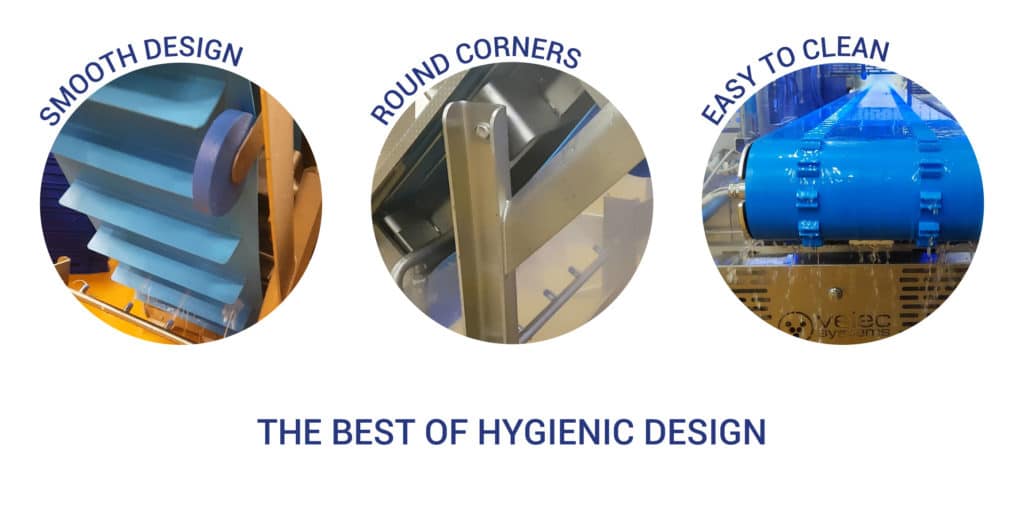
Every surface that contacts food — or sits within the splash zone — must be fully accessible for cleaning, whether manually or through clean-in-place (CIP) systems. No dead spots, no blind corners, no recessed areas where product can accumulate and harbor bacteria. If a surface can’t be reached by a cleaning solution or verified by an operator, it’s a contamination risk.
Self-Draining Surfaces
Equipment must be designed so that all liquids — product, cleaning solution, condensation — drain completely after every wash cycle. Standing water is a direct path to microbial growth. All surfaces should slope at a minimum of 3° toward designated drain points.
Smooth, Continuous Surfaces
Welds on food-contact surfaces must be ground flush and polished. The accepted surface finish for food-contact stainless steel is Ra ≤ 0.8 μm. Pits, crevices, and rough welds create microscopic harboring points where bacteria survive cleaning cycles and recontaminate product.
Minimal Fasteners and Joints
Reduce bolts, screws, and threaded connections in food-contact zones wherever possible. Where fasteners are unavoidable, specify hygienic-type fasteners — smooth-head, captive, or sealed. Open threads trap product residue and resist even aggressive CIP cycles.
Tool-Free Disassembly
Equipment that operators can take apart without tools gets cleaned more thoroughly and more frequently. If disassembly requires a wrench and twenty minutes, operators will shortcut the process. Design for access and you’ll get compliance.
Sealed Hollow Sections
All hollow areas — frames, legs, rollers — must be permanently sealed or designed for inspection and cleaning. Unsealed hollow sections collect moisture internally, support hidden microbial growth, and corrode from the inside out. By the time the problem is visible externally, the structural damage is done.
Compatibility with Cleaning Chemicals
All materials and seals must withstand the facility’s full cleaning regime. In most food processing environments, that means repeated exposure to caustic detergent, acid rinse, and quaternary ammonium sanitizer at elevated temperatures. A gasket that degrades after six months of CIP cycles is a food safety failure, not a maintenance issue.
Materials & Surface Finishes
Material | Common Use | Surface Finish | Notes |
|---|---|---|---|
304 stainless steel | General food-contact equipment, frames | Ra ≤ 0.8 μm (food-contact) | Standard choice for most applications |
316 stainless steel | Salt, acid, or chloride environments (meat brines, cheese, pickled products) | Ra ≤ 0.8 μm | Higher corrosion resistance than 304 |
FDA-approved polymers (UHMWPE, PTFE, acetal) | Conveyor components, guide rails, wear strips | Smooth, non-porous | Must be FDA 21 CFR 177 compliant |
FDA-approved elastomers (EPDM, silicone, Viton) | Seals, gaskets, O-rings | Smooth, non-porous | Must withstand CIP temperatures and chemicals |
Anodized aluminum | Non-contact structural components only | — | Not suitable for food-contact surfaces |
The most common material selection error is specifying 304 stainless steel in high-chloride environments — meat brines, salt curing lines, and pickling operations — where 316 stainless is required. Chlorides cause pitting corrosion in 304 grade, creating surface defects that harbor bacteria and cannot be cleaned to an acceptable standard. The cost difference between 304 and 316 is minor compared to the cost of premature equipment replacement or an audit non-conformance.
Common Hygienic Design Mistakes
- Unsealed hollow legs and frames — Moisture enters through hairline cracks, supporting internal corrosion and microbial growth invisible from the outside. Specify permanently sealed or fully drainable hollow sections.
- Horizontal surfaces that trap product — Flat ledges, equipment tops, and cable trays accumulate debris and moisture between sanitation cycles. Slope all surfaces or add covers.
- Inaccessible areas behind guards or panels — If operators can’t see it or reach it, it doesn’t get cleaned. Require tool-free removable guards with quick-release latches.
- Thread-type fasteners in the product zone — Open threads trap product residue that CIP cannot remove. Use smooth-head hygienic fasteners or weld-in studs with cap nuts.
- Mixing incompatible metals — Galvanic corrosion occurs wherever dissimilar metals contact each other, such as carbon steel bolts in stainless steel frames. Use matching or electrically insulated fasteners.
- Specifying equipment without EHEDG or 3-A certification — Uncertified equipment may look the part but fail under audit scrutiny. Always request and verify third-party certification documentation before purchase.
For examples of how these principles come together in a complete production environment, see how a hygienic sausage processing line integrates sanitary equipment design from intake through packaging.
Hygienic Design Checklist
We’ve compiled a downloadable hygienic design checklist covering equipment evaluation criteria for food processing lines. Use it when specifying new equipment, auditing existing installations, or building a business case for equipment upgrades.
[Download the Hygienic Design Checklist (PDF)] (placeholder — design/marketing team to create and insert downloadable PDF asset here)
FAQ
What is hygienic design in food processing?
Hygienic design is the engineering of food processing equipment so that all surfaces can be effectively cleaned, bacterial harborage is structurally prevented, and the equipment meets regulatory food safety standards. It covers everything from surface finish and material selection to drainage angles and fastener types, and is evaluated under frameworks including EHEDG guidelines and FDA Current Good Manufacturing Practice regulations.
What is the EHEDG standard for equipment design?
EHEDG is a European-based organization that publishes design guidelines and operates a certification program for equipment used in food and beverage production. Key documents include Doc 8 (hygienic equipment design criteria), Doc 13 (open equipment design), and Doc 44 (belt conveyor design). Equipment that carries EHEDG certification has been independently tested for cleanability, giving processors documented evidence of compliance for audits.
What surface finish is required for food-contact stainless steel?
The widely accepted standard for food-contact surfaces is a roughness average (Ra) of ≤ 0.8 μm. This applies to all stainless steel surfaces that contact product directly, including conveyor beds, chutes, hoppers, and processing vessels. Rougher finishes create micro-crevices where bacteria can survive standard cleaning and sanitizing procedures — see the materials table above for grade-specific guidance.